Life before death. Strength before weakness. Journey before Destination.
The Way of Kings“Life before death. Strength before weakness. Journey before Destination.” is the First Ideal of the Immortal Words and the common motto of all ten orders of the Knights Radiant. Its decisive significance is that it defines Radiance not merely as the ability to infuse and command Stormlight, but as a way of living: protect life, use strength in service of the weak, and value the moral path toward a goal above the goal’s mere accomplishment.
Definition and Origin
Teft explains the expression to Kaladin while describing what it meant to be a Radiant. A Radiant could drink in Stormlight and command it, but that power alone did not constitute the order’s identity. The deeper standard was the Immortal Words, a set of Ideals that guided everything the Knights Radiant did. The First Ideal was shared by every one of the ten orders, while the four later Ideals differed according to the particular order.
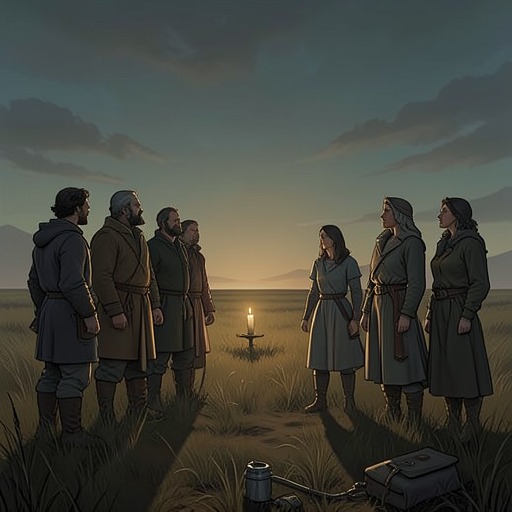
The book’s opening presentation places the words in the historical shadow of the fallen Knights Radiant. The ancient oaths are presented alongside the call to return the Shards once borne by their possessors, followed by the declaration that the Knights Radiant must stand again. The expression therefore functions both as a surviving remnant of a lost institution and as a possible summons to its restoration.
The Three Principles
The first clause, “Life before death,” makes preservation the Radiant’s primary duty. Teft says that a Radiant seeks to defend life, never kills unnecessarily, and does not risk personal life for frivolous reasons. The principle reverses the assumption that dying for a cause is automatically nobler than continuing to live for it: living is harder than dying, so the duty is to endure and remain capable of protecting others.
“Strength before weakness” turns power into an obligation rather than a claim to rule. Teft acknowledges that every person is weak at some point, and therefore defines the strong person’s proper response as protection. Strength is not evidence of entitlement to command; it is a capacity for service. The clause gives the Ideal a social dimension, directing Radiant power away from domination and toward those who cannot protect themselves.
“Journey before Destination” governs the means by which a goal is pursued. Teft stresses that every goal can be reached in several ways and that failure is preferable to victory achieved through injustice. Protecting ten innocents does not justify killing one. Because all people eventually die, the decisive measure is how a person lived, not simply what was accomplished. The final clause consequently binds the other two to a method: preserving life and serving the weak must themselves be carried out without abandoning moral judgment.
The Ideal in Practice
The expression is introduced to Kaladin in a moment when survival seems difficult to distinguish from defeat. Teft admits that he does not know the ultimate point of their suffering, but regards surrender as pathetic and insists that they should keep fighting until the arrows take them. He invokes the journey principle without initially understanding its full meaning, having only heard it before. This incomplete recollection becomes a first, rough contact with an ethical language that later receives a more exact explanation.
Teft’s teaching also separates Radiant identity from supernatural ability. Kaladin is told that Stormlight may be commanded, yet the refusal or acceptance of that power is connected to conduct and outlook rather than technique alone. The First Ideal thus supplies a standard by which action can be judged even when the outcome is uncertain: survival is protected, strength is shared, and the route to victory cannot be treated as morally disposable.
The Oath and Its Consequences
The words acquire renewed force when a mysterious figure speaks them to Dalinar and connects them with the return of the Shards and the restoration of the Knights Radiant. The declaration is not presented as historical commentary alone. It is an imperative to speak the ancient oaths again, recover what humanity once possessed, and stand against a danger that cannot be overcome through isolated struggle.
The figure immediately links the Ideal to collective responsibility. Men must face their enemies together, because division can make them their own enemies; the adversary need not defeat them directly if it can make them forget, turn against one another, and repeat the failures of the past. The words therefore operate on two scales. They govern the individual’s treatment of life, weakness, and moral choice, while also expressing a political and communal demand for solidarity.
Narrative and Thematic Significance
As an expression, the First Ideal provides a compact counterweight to a world organized around expendability, hierarchy, and weapons that can decide the fate of kingdoms. Its three parallel clauses move from existence, to social responsibility, to ethical process. The structure makes the motto memorable, but its content resists simplification: living is a duty, power is service, and success without justice is failure.
The phrase also becomes a test of the distinction between destination-centered heroism and genuinely principled action. The book’s surviving summons does not promise that the Knights Radiant will immediately triumph, nor does Teft’s explanation guarantee that adherence to the Ideal will produce easy victories. Instead, the expression makes the path itself consequential. It asks whether protection remains protection when it is inconvenient, whether strength remains strength when it serves rather than rules, and whether a desired end is worth pursuing if reaching it requires abandoning the values that were meant to justify it.
In this way, “Life before death. Strength before weakness. Journey before Destination.” is both a relic and a beginning. It preserves the moral vocabulary of the Knights Radiant, teaches the principles that their power was supposed to embody, and becomes the first formulation of the larger demand that the order stand again.